Tuesday, November 12, 2013

The Power of Networking.... Maximizing Every Handshake


Networking, as defined by Webster Dictionary is, “a supportive system of sharing information and services among individuals or groups having a common interest.”  Today we live in a business climate in which the demands on us as individuals can be almost overwhelming.  It moves at light speed; change is constant, and the ability to keep up with it all seems impossible.   With this fast paced and changing environment, in a world where we can never really “know it all”, why would anyone try and go it alone?  

The first key to any advancement or growth in personal life, professional development, or business, is surrounding yourself with a constantly growing network of people who can provide you or your organization help at any given time.  To build a network of people effectively, you have to understand the art of networking.  In my opinion, networking is one of the greatest life skills never taught to us as children or as business people, yet we are called upon to do it everyday.

The way to build a network is not about entering a conversation to see what a person can do for you.  The first step in networking is to get to know people and see how you can help them.   Zig Ziglar stated years ago, “If you help enough people get what they want, you will always get what you want.”

Recently I attended the MPI WEC meeting at Amelia Island, Florida, where I heard Laura Schwartz    She stated over and over that while she was working her way up through the ranks, whenever she would enter any social event and meet people, her number one question was, “How can I help you?” 
speak about how she rose from the position of intern at age 19 in the White House, to the Director of Events and Meetings for the White House. Ultimately, she produced every event President Clinton was involved with.

In the world of networking, people always remember those who have helped them be successful, and typically they are more than willing to return the favor.   The key to this element is that you give to help them achieve their goal without expectation of the return favor…that makes it genuine.  To be the best at networking, you must be a giver of help…not a taker.

As stated earlier, networking is about a connection to a group of people who, through your positive relationship, can help you at any given moment.  The key to a network is in your common interests or needs.  Some areas to think about building a network in would be:
  • Groups with similar interests
  • Individual with similar needs
  • Same age range
  • Mentors
  • Sphere’s of Influence
The second key to networking is to know yourself and others.   Take time to understand the strengths and weaknesses of the four different personality types.  The most successful networkers I’ve ever experienced have always been able to identify what makes people tick within minutes of talking to them.   Knowing this allows them to know “how” to talk to them.  Some people want to hear vision…some want to hear about your family…some want to hear the bottom line.   If you would like to see the strengths and weakness of the four personality types, you can visit www.tommorrison.biz and click on “Tom Morrison’s Handouts”.  There you will find a downloadable document that will be very eye opening about yourself, as well as, the people you meet.   The four personality types have all been characterized in many ways, including Greek words, shapes, animals, and colors.  They all break down to four:
  • Life of the Party
  • Decision Maker
  • Perfectionist
  • Can’t We All Just Get Along

Think about it…if you were about to enter a room full of people who spoke four different languages, wouldn’t you have a much better experience if you knew all four of the languages, and could talk in a way that they all understood every word you said?  The same is true with personality types.  We tend to speak to a person, like we are talking to someone who thinks just like us…big mistake.  You need to talk to people in a way that “they understand what you are wanting to communicate.”

The third key is to understand that networking is continuous and perpetual…it never stops.  Every time
you enter a room or shake a hand, it’s an opportunity to meet someone who may be the connection you need for a job a referral or help getting in the next door.

I know what many of you are saying at this point, “But Tom, I’m not a people person.  I’m uncomfortable in a room full of people, especially people I don’t know.”  Let me assure you that many people you may meet in that room feel the same way.  So my encouragement to you is to step out of your comfort zone, and introduce yourself.  At the end of this article, I will share a simple system for you to use on how to start up and move a conversation forward with anyone.

A few other keys you need to note on being a power networker are:

Be Viral:  A ton of networking and connection takes place online with LinkedIn, Facebook, Instagram, and Twitter.

Minimize and eliminate time wasters:  Your time is valuable and while you are talking to someone who has no interest in who you are, you are missing out on connecting with someone who will be a vital connection to your life.

Listen with your heart and often:  Simply put, be genuine and hear people’s stories.  Don’t fake whoBe real and transparent.  When you open up your heart to people and listen to theirs, that is when the ultimate connections are made.

Always be aware of where you are, who you are with, and who could be watching:  There’s a time and place for everything.  In the world of networking, you want to make sure you aren’t letting your hair down in an environment that could have negative consequences to some future opportunities you may have.

Be curious:  Ask lots of questions and get to know who you are with.  People LOVE to talk about themselves and what they do for a living.  They love to brag about themselves, leverage that to your advantage.  Share your wisdom when asked.  Always ask people for permission to give them feedback.  Help people create ideas and solutions.  Don’t be afraid to challenge ideas.

Remember and use names:  People love to hear other people call them by name.  If you don’t think so, try saying, “Thank you INSERT NAME”, next time you purchase something.  You will see the person smile.  Calling someone by name says, “You were important enough for me to remember your name.”

Not everyone will like you:  Remember that we are all different.  Not everyone likes certain personalities, there are differing opinions, many people have a past history that won’t allow them to like who you are and some are going to be jealous of you for whatever reason.  Don’t let it deter you…move on, they are most likely time wasters.

Everybody is somebody:  Always assume you need to meet a person…never under estimate who you  That person could know the person who is your next boss or next big client.  Always treat everyone you meet with respect and honesty as if they are the person who knows someone else you need to meet.
are shaking hands with.

Business cards:  Like the American Express commercial says…“Never leave home without it.”  These are how people remember you once you leave their presence.  The next level is to have a QR code people can scan with their phone, this way you are in their phone immediately.

Now that you know the keys to networking, I want to share with you a simple system for connecting with people once you have entered the room.  As you approach someone at the bar, or just in a small group, you have just reached out your hand and said typically, “Hi, my name is…..”  Most people don’t know what comes next.  Here is what comes next, it’s called F.O.R.M. 

FAMILY – everyone likes to talk about their family, so you start with simple questions like:
  • Where are you originally from?
  • Does your family live here?
  • How long have you and your wife lived here?
  • What are your kids into at their ages?

At some point, you then will transition into:

OCCUPATION – most people like to talk about what they do whether it’s good or bad, so you move into these questions:
  • So what do you do for a living?
  • How is the economy in that industry?
  • What are the major challenges a company like yours is seeing right now?
  • What do you like most about your job?

RECREATION – people have passions or outside work activities that they love:
  • When you aren’t at work, what do you like to do?
  • What do you like best about that activity?
  • Are you a sports fan?
  • Who is your favorite team?

After talking with someone about their Family, Occupation, and Recreation, it is now MY TIME.  The problem is you never get to “MY TIME” because you spent so much time letting the other person do what they like to do most…talk about themselves.

Your letting them talk so much about themselves, leaves them thinking you are this incredible listener, and an awesome person they just met.  BOOM!  Connection made.


Again, networking is a life skill everyone should master.  Start working on your ability to connect.  You never know which hand you shake that will change your life forever in the future.  A hand I shook in 1995, called me in 2005 to ask me if I would come be his #2 guy to take over as CEO when he retired in two years.   He said, while interviewing me, he always remembered how passionate my ideas were when he met me 10 years earlier…I was his only call to be his #2 person.

Monday, September 23, 2013

Long Live Your Education Sessions: How To Repurpose, Reuse and Recoup Meeting Costs


Over the last six years, if there is one thing I’ve learned, it’s all content, if relevant, can be repurposed for new use.  Our organization lives in the world of materials and science where the content that was developed years ago is still relevant today.  The question for any association in this situation is, “how are you changing its delivery and purpose to engage your members in new learning styles?” 

These new learning styles are incredible opportunities for your association to create new income streams.

Many associations have printed content, some in book format, a lot in electronic format just lying around.  They have videos sitting in a closet.  They have PowerPoints that have been used in prior general sessions.  They are hosting conferences with no video camera in the room capturing what could be an incredible income stream for their association.

All of the above are pieces to a new revenue model called, “Repurpose, Repackage, Reuse,” to selling knowledge to your members.

Let me give you an example of how this looks in the real world.  Our association had a five module course that included a thick 3-ring bound Instructor’s Guide, five student handbooks and written tests.  The thick Instructor Guide was OVERHEADS!  Yes overheads. 

This program sat dormant for 2 years with none sold.  Then, one day the light clicked on.  We began to ask the famous… “What if we….?”  The “what if we” was, what if we converted the overheads to PowerPoint?  What if we partnered with one of our industry professionals to create 2 hours of video for each module to take the teaching out of the member’s hand?  What if we also gave an option for members to take the course online and call it the Qualified Furnace Operator Program?

One thing led to another and within a few weeks, we had everything we asked for:  A totally repackaged product that started selling like crazy in both print and online.  The print version sold for $1,200 while the online version sold for $1,000.   Within just a couple of weeks, we sold $20,000 of the printed version with many others taking the course online through our subscription program.

The key to the whole innovation was inventorying our content and then starting to ask… “What if we….?”

The next bit of innovation was purchasing a $300 HD camera and a tri-pod.  We began to take it with us to all of our regional conferences and video taped our sessions with the approval of our speakers in our agreements.  Most speakers were industry professionals and wanted the exposure.  We then began to build our online content, one live meeting at a time.  Now we have over 200 hours of content and over 350 courses being taken each month.  This has lead to an annual income stream of over $100,000 in just seven years.

And that content makes us money for as long as we can deliver it effectively.

“Small firms” like Boeing, Eaton Corporation and FedEx are all clients to our online learning center.   We finally found the golden nugget that pulled the big companies into our membership space.

By repurposing, repackaging and reusing content, it has enhanced our member engagement and increased our revenue per member from $1,500 in 2006 to $2,200 in 2013.  With our size membership, that was another $180,000 a year.  That is 100 new members we did not have to recruit!  That was huge!

Remember this…  it is more cost effective to convince your current members to spend their money on meaningful programs than it is to recruit new members.

In closing, I would encourage anyone reading this post to do the following:

1)    Inventory your current content or print, electronic, Power Point presentations and videos
2)    Inventory your meetings of all types and determine which you could record
3)    Seek out industry professionals who could put video to your printed content and PowerPoints
4)    Brainstorm an industry certificate program that members receive when they complete  “x” number of training hours
5)    Most importantly…  get your team together with all this information and then start asking the question:  “What if we…(insert idea)?”

Educations and training, done right, can be like printing money for any association.  Start your printing press today.

Thursday, September 5, 2013

How Crazy Our Thoughts Get About Employee Retention...GET REAL!

I recently found two different threads of discussion most amusing on the ASAE online forums, related to the retention of employees, and board members "poaching" or recruiting one of your association employees to come work for them.  I was amazed at some of the conversation!  Many execs had no idea, or plan to maximize employee retention, and actually thought it was a good thing to control and discourage advancement of employees, by keeping them from leaving...even if it was to a member company.  I received so many positive emails regarding my responses, that I thought I would share my thoughts on my blog.

In my experience as an association executive, I've found employee retention to be easy.  By applying 8-simple ideas, I've never had anyone leave in 18 years of leading 2 associations.

...now that doesn't say someone will not leave, because someone may offer them a position in the top 5% of pay.  However, I've experienced that if you do the 8 things I speak of below, your employees will not actively go looking for employment...someone will have to find them.  That is huge in the area of having confidence that when you are traveling or not at the office, your employees are working to grow and protect your association, not on monster.com or networking online with other friends to find another association job.

As leaders, we make being employed way too hard.  Many associations want to pay cheap labor, with no benefits, for someone to come in and be passionate about their cause everyday, and they are shocked when they leave.  The management philosophy of many is:  "JUST DO YOUR JOB.  YOU SHOULD BE HAPPY TO HAVE ONE!"

If you aren't doing any of the 8-steps I speak of below, you are always at risk of losing people. 


If you don't want your staff to be tempted to leave, and say "NO" to any other offers, then take my advice and make sure you have the following 8 steps in your employee service strategy:

1) Treat employees with respect
2) Be fair
3) Communicate expectations openly with them
4) Pay them well (in the top 10 to 20% of their field)
5) Do something once every other month to say, "I care about you"
6) Give them an exciting, flexible, and positive environment to enter into everyday

7) Know their personal goals so your association is helping them to achieve them
8) Give them an incentive to grow through promotions or bonuses

These eight things must be backed up with actions...not just words.  Your employees will follow you wherever you go...not just where you tell them to go.


I'll give you a personal example of how you show you care as an association/employer.  As I was doing some planning for the future, my employees asked me, "Tom, what happens if you get hit by a truck or die prematurely?  What does that do to your contract, and how are we impacted?"  Like any management contracts, upon death, mine ends, meaning my employees have no job.  When you only represent one big client, that thought is unnecessary pressure on your staff.  I took that conversation to heart.  A month later I sat down with my employees and told them that I had taken out a life insurance policy on myself.   If I died prematurely as owner of my management company, they would pay each of my employees one-year's salary.  That one simple gesture gave a ton of relief to everyone.  If something happened to me, they now had a year to figure out (and find) what they would do to help generate income in their households.  That is called showing you care with actions...not just words.  Do you have actions...or just words?

Regarding board members recruiting an employee they feel could be of great value to their company, I say, "you can't control it".  
Some things in life you have to say, "I can't control it, so I'm going to make the best of it", and look at being a mentor to your people instead of trying to control their advancement.


I come to work everyday as CEO knowing because we put a lot into our people and demand the best, that one day, someone may offer them an opportunity that we certainly can't match.  It makes me proud to know that I've helped to make that person so valuable in the marketplace.

It makes me think how proud pro-football coach Bill Walsh, from the San Francisco 49ers must feel, looking around at the last 15 years, and seeing how many of his key assistant coaches are now head coaches... who were hired right out from underneath him.

Instead of having your head in the sand about your employees potentially being recruited away, network well enough so that other association staff know you do the above 8-things.  You will have highly qualified staff members from other associations lined up to work for you within days of your person leaving.

Don't live in a bubble.  Don't assume employees are never looking for another job.  Employees typically leave because of adverse working conditions caused by a boss, needing more money, or needing more benefits.  The question for you is...are you providing them the best in all of those areas?  Remember, the average person's home life is not an encouraging and fun filled adventure...it's tough.  If you give them an exciting, encouraging, and personally fulfilling place to be everyday, it will take a life-sized opportunity for them to leave.  

Monday, August 12, 2013

Staying Fit on a 3000 Calorie Per Day Conference Diet....REALLY????

After returning from ASAE 2013 in Atlanta, I did a lot of self-analyzing about what I experienced with
regards to calorie consumption for 5 consecutive days.  Atlanta and its sponsors rolled out the red carpet for attendees, as any city does for ASAE, and we greatly appreciated it.  Alone, it wasn't a big deal at ASAE 2013 or at any other event, however, when you look over the course of a year at how many conferences, seminars, meet & greets, lunch & learns, and site visits we experience, it's a wonder we haven't exploded (no pun intended) under the pressure we put on our bodies from the excessive calorie intake.

It took me back to my late 30's at my first association.  Over a 12-week period I gained 30 pounds quickly, as a result of participating in numerous networking/legislative all-you-can-eat and drink functions.  I didn't even realize it until I went to the grocery store, and stood on the scale, that something was seriously going on with my weight.  After 12-weeks, I had gained 30 pounds, and the ONLY thing that was different in my life was the all-you-could-eat and drink calorie in-take at my association functions.

Studies show upwards of 80% of healthcare costs come from behavior lifestyle choices that people make.  These choices include (but are not limited to):   poor diet, lack of exercise, smoking, lack of sleep, and/or excessive drinking.   These behaviors can lead to obesity, high blood pressure, diabetes, stroke, heart attack, and metabolic syndrome, just to name a few.  Now, I'm not trying to throw fear around lightly, but rather, trying to be real about the consequences of our habits and choices when it comes to the serious over consumption of calories in the association "lifestyle".

It really hit me when my wife, DeAnna, Owner and Creator of Fit in Your Pants, LLC, and www.fitinyourpants.com shared with me the fact that over two-thirds of American adults are considered obese.  It made me think: "How healthy is the association and hospitality industry, given how many calories we consume over the course of a year?"  ...and I don't see very many execs in the workout room when I'm walking past it, so we aren't burning the calories off.

Over my 18 year career, I have found it amazing the amount of calories, we as association professionals, and even the hospitality professionals, consume in the course of our conference/meeting.  ...and one of the biggest reasons is, it comes so easy to our fingertips, and in unlimited fashion.  This is how a typical day can be for many at conference:
  • Full breakfast (or worse, just pastries and bagels)
  • Morning break (with sodas and cookies)
  • Lunch (with bread and dessert)
  • Afternoon break (with more sodas and cookies or ice cream)
  • Sponsored evening receptions
  • Hors d'oeuvres before dinner
  • 4-course dinner
  • Desserts to die for
  • More post dinner networking receptions 
  • After hour hospitality suites
Don't get me wrong...this kind of a day, in and of itself, is not a bad deal for you...at one or two  conferences a year.  BUT in the association and hospitality industry, this is a constant...we live this schedule day in, and day out.  Again, it's not bad, but we need to consider how we manage it so it's not damaging to our health over the long haul.

The reason I decided to write on this topic is my concern for the physical health of our industry, and the people I know and care about in it.  I personally live a very active and fun lifestyle at any conference I attend.  I love the networking, and come with lots of energy, do lots of crazy stuff that many say they can't do, and typically dance til late into the night with my friends.  

Many ask, "Tom, how do you do it?"

Well, in my early 30's, I didn't need to have a plan because the calories just ran off my body, and weight just stayed away.  Now, in my late 40's, those same calories hang on for dear life, and the weight is like a magnet to my body.  I knew that if I kept up the "conference lifestyle" in my 40's like I did in my 30's, I was sure to drive my health into the ground, and not be able to maximize my enjoyment of the people and experiences that are so important to us all.
When my association friends are wanting to go out dancing, kayaking, mountain biking, zip-lining, skiing, white water rafting, or run a 5K, I don't want my body to say "no".  I came to the conclusion that I needed to think and act differently throughout the year at any association function.  

So over the last year, with the help of my wife, who is a Personal Trainer and Health/Wellness Coach, I've developed a balance of disciplined eating, moderation, and fitness that keeps my body feeling young, energetic, and fit.  Three things you need to know about keeping your body at a weight you feel good at are:

  1. 80% of weight loss comes from the kitchen (what you eat)
  2. You can NEVER workout more than the calories you consume
  3. To get to the weight, and have the toned body you desire, you MUST do both:  disciplined eating and fitness
For those of you who say, "Tom, I travel too much or don't have the time", your excuses can disappear.  Now with companies like Fit In Your Pants, you can have access to mobile personal training that you can do anytime, anywhere.   I consistently do my workouts in my hotel room, with no weights, and I feel great for meetings...more energetic during the day because I'm burning the calories I'm consuming at conference, and I'm mentally more fit as well. 

Now I don't want any of you to be thinking, "Wow, I can't enjoy my conference experience nearly as
much now."  You can, but with some slight shifts in conference consumption habits, and moderate fitness training.

To help you walk away with some serious take-aways that will transform your life, I've put together a list of "10 do's" and "10 don'ts" to help you be more proactive in managing your conference experience.  These 20 small action steps will help you work towards a more healthy and long-lasting life in the association profession.  My wife/Personal Trainer, and has provided these tips to me from her experience attending association conferences:


10 Things You SHOULD Do At A Conference
  1. Eat…don’t skip meals, BUT chose wisely (think vegi’s, and lean proteins)
  2. Pack your own healthy snacks to carry in your bag.  This will help you to avoid making bad choices because of low blood sugar.
  3. Chose vegi’s and fruit over other less healthy choices (bread, pasta, dessert)
  4.  Eat dessert, BUT only have a bite or two.
  5. Drink like a fish…WATER.
  6. When drinking mixed drinks, let the mixer be water.
  7. Take your vitamins (especially your B12)
  8. Try to get 8 hrs. of sleep.
  9. Make time to sweat everyday (even 15-20 minutes of exercise is better than nothing)
  10. Have a glass of water in between each “adult” beverage

10 Things You Should NOT Do At A Conference
  1. Avoid the high calories/high carb breakfasts (bagels, doughnuts, pastries)
  2.  Say “No” to the bread and butter on the table.
  3. Skip the high calorie/high fat snacks.
  4. Don’t do soda…not even diet.
  5. Avoid the temptations at the booths (candy, cookies, and other junk food)
  6. Don’t do “seconds”…only one pass through the buffet.
  7. Say “No” to the floating appetizer trays (or at least only have one)
  8. Avoid the sweet, “fluffy” mixed drinks (there can be as many as several hundred calories in EACH drink)
  9. Don’t sit for long periods of time (you burn more calories standing and walking)
  10. Don’t go with the attitude that you’ll eat, drink, and be merry with reckless abandon for several days…it WILL be waiting for you when you get home and step on the scale.
...and remember, along with these 20 shifts in thinking, find a good mobile workout program you can do in your hotel room every other day.  With disciplined diet, moderation, and a fitness program, you can maintain a healthy lifestyle that will keep your waistline slim, healthcare costs down, and maximize your life and conference experiences.

Make a personal commitment to change your habits for your spouse, kids, family, friends, and co-workers who depend on you.  Years down the road, you will say it was the best decision you ever made, and you'll be adding years to your life, and life to your years!

Sunday, August 4, 2013

Online Education: How It Can Print Money For Associations

In today's association environment, it is imperative associations look outside their dues structure to add value to members and much needed revenue to their funding sources.  When looking at new or current programs, there are always three types of programs associations offer:
  1. Ones the members can get for free anywhere
  2. Ones the association is going to do whether they are members or not
  3. Ones the association does better together than the members can do themselves
I'm here to tell you that if most of your value to your members is based on #1 and/or #2, your value proposition is at serious risk.  It is crucial you dig into your members daily lives as professionals and businesses and understand what are their big challenges.  Members are spending big money on outside consultants to fix problems in their business that the association could be spending.

Engaging members in programs "together", where they can leverage their budgets and maximize their performance, is the perfect type programs and services associations should be pursuing.  Effective non-dues revenue programs that are meaningful to members can have a dramatic impact on an association's budget.

Once our association began to dig into meaningful programs for our members, our non-dues revenue began to grow like crazy through member engagement.  The following graph illustrates the impact the programs have had on our associations "per member revenue."

At one time, we took in about $1,550 per member on an annual basis.  Now our association generates over $2,200 per member.  That is an extra $227,000 a year in revenue.  We would have to recruit 126 new members to equal that same revenue.  As we all know, it is a much cheaper investment by the association to get current members to spend more money with the association than it is to recruit new members.

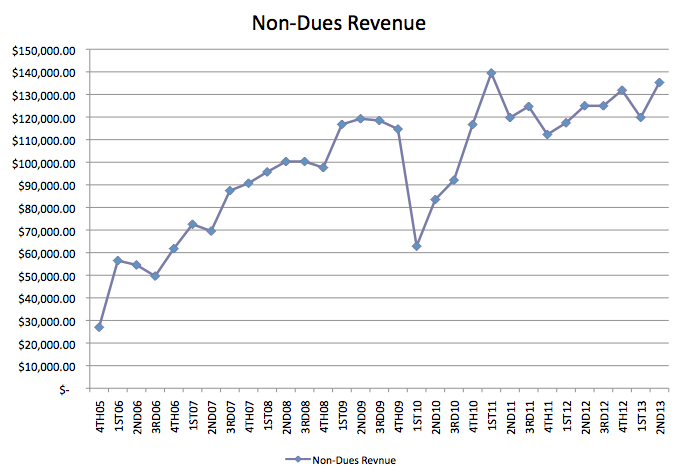
The impact of raising our per member revenue through more effective non-dues programs has been amazing.  The following graph illustrates our growth in annual non-dues revenue:


As you can see, our non-dues revenue has grown from less than $30,000 a year, to now almost $140,000.

One of the biggest drivers of that new non-dues revenue is online education and training.  Here's how online education fits the criteria for the perfect non-dues revenue program:

  • The association can do it more effectively than the members
  • It has high profit margins
  • It takes minimal staff effort with the right learning management system

As of this year, our association has an online learning academy that:

  • Generates almost $100,000 in annual revenue
  • Has over 350 course enrollments a month (over 32,000 in 7 years)
  • Has saved members over $2,000,000 in training costs over 7 years
  • Takes less than one man hour a week by staff to administer

Since its inception, our online academy has been able to deliver high quality content, in a user friendly environment, at a significant savings to our members, while driving extra revenue to the association annual budget.

I highly encourage all associations that do not have an online training strategy to seek one out.  If you have content in any format, or an industry professional you can partner with in a revenue sharing arrangement, you are sitting on the same opportunity to drive new revenue to  your association.

From my experience, the keys to a successful online learning strategy that engages your members in the program are as follows:

Need to Establish a Culture of Training Within Your Membership
It is proven by studies that companies that train their employees have higher morale, more confident employees, less error rates, higher gross profits, embrace change and accept technology easier.
Associations need to brand that thinking in order for members to take training serious.  They need to see the positive impact training will have on their career or business profits/productivity.

A User Friendly Learning Management System (LMS)
Whichever LMS you choose, you must have the following three items for you to maximize net revenue and minimize staff involvement:
  • Content creation, of courses, is point, click, upload environment
  • User friendly to the member in navigation
  • Cost structure to your association that allows your association to maximize your revenue
Content That is Relevant to Your Members Needs
Associations typically have content without even knowing it.  If you have written content, videos, power points, or past conference sessions, you have content to consider for your online learning center.  If you don't have that, you may have an industry professional, who for a 2-year revenue sharing opportunity, would create content for your association.  We gave an industry professional 20% of course revenues for two-years and he created 43-hours of videos, power points, and tests for us.  The point is, every association has content.  You just need to find it with yours, get it online, and sell it.

Certificate Specialist Program to Keep Members in the Program Long Term
We have found, employees love to accomplish training goals, and employers love to post those certificates of those who reach their goals.  It looks good to customers and motivates the other employees.  Certificate programs are easy to create.  You don't need to certify that someone is qualified at a certain level of performance...that comes with liability.  What you can easily create is a certificate program that certifies a person has taken at least so many hours of training and worked for at least a certain period of time in the industry.  The certificate demonstrates they have had some minimum level of knowledge based, and on-the job training.

Unlimited Subscription Model Availability
99% of our training engagement comes from members who purchase an annual subscription for unlimited use of our online learning academy.   With the financial cost structure we had with our LMS, it made it possible for us to take the video rental model of purchase courses one at a time for a certain price, or pay a higher price and get unlimited usage of our over 200 hours of training for your company.  Members jump all over the unlimited subscription model given it was highly competitive, provided them a group account to track all their employee's progress, and everything was tracked online, so it fixed their training budget each year.

In closing, I would encourage anyone reading this post to research and explore an online education strategy.

Wednesday, June 26, 2013

Tracking Your Membership Engagement... It's An EYE OPENER

An amazing thing happened this past month in the area of membership engagement.  Our Chief
Administration Officer, in charge of all our data, downloaded all our member activity to an excel spreadsheet and passed it onto me to review.  As I started looking over the data, it became apparent that we, for the first time, had the data right in front of us to truly measure our membership engagement in an easy and readable format.  We could sort and categorize members by:
  • Very engaged
  • Actively engaged
  • Somewhat engaged
  • Not engaged
This was incredible because now we can start targeting these members with different messages depending on their engagement.   The numbers showed we have 84% of our members engaged in one of more programs or services that are meaningful to their organization.  A more detailed view looked like this:

- 14% - Very Actively Engaged (6 - 11 programs)
- 26% - Actively Engaged (3 - 5 programs)
- 44% - Somewhat Engaged (1 - 2 programs)
- 16% - Not Engaged (0 programs)

Here is the key behind membership engagement:  Many look at engagement through the eyes of their meetings and volunteerism.  The philosophy being that if you don't come to meetings or volunteer, then you aren't engaged.  That couldn't be farther from the truth.

Many associations struggle because past coming to meetings and volunteering, their is no "actual" value.  It is "perceived" value.  The biggest mistake you can make as an association is to try and sell a "perceived" value to your members.

I was sitting in an association meeting I'm involved with recently where the staff liaison to the membership committee said that on their last conference call, everyone was stating, "If they don't come to our annual conference, we don't know what to tell them on why they should be a member."  That's a serious problem.

Keep in mind, according to the 2011 Marketing General Association Survey, only 22% of members on average attend their annual conference.  This leaves 78% unengaged with the association through their meetings.  Another figure to keep in mind is that the #2 reason members stated they dropped membership was a "lack of engagement" in the association.  Hense, if they don't come to meetings or aren't a volunteer, your value proposition is in serious jeopardy.

Knowing these two stats should send a RED FLAG up the fire pole that, as an association, you need to have some very specific programs or engagement for those non-attending members of your conference.

When analyzing this, there are three types of member segments that engage in your association;

1) Informational - They get data from you in one way or another
2) Transactional - They purchase something from you
3) Emotional - They volunteer or attend meetings for face to face networking

The easiest members to keep around are the emotional members because they have a connection to a
human being or the "cause" that keeps them in the association.  That is a minority in most memberships.  As the numbers showed above, the vast majority of members are those who are information or transactional.

When we looked down our list of benefits on the member engagement spreadsheet, we realized that we have 14-benefits that play a key role in any member's business.  Having members broken out by engagement segment will give us a marketing advantage because now we can thank and reward those who are really engaged and encourage those who are not.

The moral of the story is:
  • According to Marketing General's study, member engagement plays a huge role to non-attending members maintaining their membership.
  • Have you measured, in some fashion, your member engagement?
  • Have you separated your members into the 4-categories of engagement?
  • Do you have a communications plan to send different messages to each?
  • Do you know who your informational, transactional and emotional members are?
  • Is your association's value outside of meetings and volunteering "perceived" or "actual"?
When it comes to providing value, their are three types of benefits for your association to provide:
  • Those members get for free 
  • Those the association will do whether they are members or not
  • Those the association can do more effectively together than members can do themselves
I would encourage everyone reading this post to list every benefit a member can take advantage of and ask yourself two questions for each:
  1. Is this benefit a "perceived" value or "actual" value to the member?
  2. If it is "actual" value, state on paper the answer to, "How does the benefit have a lasting and measurable impact on a member?"
If you can answer "actual" to question one and have a good answer for question two, then keep the benefit. All others, toss because they have no real value to the member.

Get with your leadership in 2013 and build your membership engagement strategy.  Look at the different segments of engagement, send them more targeted messaging, design benefits that have actual value and are things you do better than your members can do themselves.

A highly engaged membership drives a higher level of retention.

Wednesday, June 5, 2013

The Perfect C.P.R. for Associations To Get Their SWAGGER Back!

Have you ever reached a point in your association where you feel like your organization is on the verge, or is currently drowning in the wrong strategic direction, marketing strategies, member apathy, tradition, or board politics?  Do you feel like you are SO under water that you will never see the light of day again?  Many associations I network with around the country are currently suffering from some, or all of the above mentioned issues.

Let's examine the numerous potential root causes that can lead associations to this point, including:


  • Poor board decisions
  • Being close minded to the change in demographics within the association
  • Not seeking to raise the value proposition to something meaningful
  • Continuing to do things they way they have always done them
  • Refusing to change with the market of associations
  • Ignoring technology advances
But take note...things are never as bad as they seem, and you can crawl, fight, and swim your way back to the surface.  All you need is effective CPR for your association!  In my experience, associations that are drowning in the above issues, really need to start some CPR to bring their association back to life.  CPR stands for:
  • Charisma
  • Passion
  • Relevance
Let's look at each:

CHARISMA
Members today don't just want programs...they want their membership to be a meaningful experience...a lifestyle where they see strength in numbers and feel a swagger by being a member of the association.  Think about it...have you ever walked down a convention hall at 10:30 pm when there are three or so conferences going on at the same time?  You always pass on the ones where there is nothing going on inside to speak of.  ...but the one where you hear amazing music, maybe some dancing, people engaging one another in discussion...then you stop and peek in because you want to know what's going on, and most likely would love to enter and find out what's so exciting with this group.  That group has CHARISMA!  They saw their final night dinner as much more than just a closing dinner...it was a chance to make memories, network with others, and emotionally connect with people.

I recall at our latest conference, being out with one of our biggest supporters.  He stood up at a dinner
of about 20 of us, and gave a toast.  With conviction, he said the tag line I say at the end of every MTI TV video:  "HERE'S TO NOT JUST BEING STRONG, BUT TO BEING MTI STRONG!"  I have to tell you, as the CEO of this group, my heart started racing, and I wanted to get emotional because I saw for a moment that we were tapping into our member's emotions.  It was awesome!

So my question to you is, does your association have CHARISMA?   Does your outreach to members draw emotion?  Do members feel a swagger about who they belong to, so as to say..."don't mess with our company, we belong to our association!"

If your association does not have CHARISMA and a swagger, I suggest you look to appoint someone to the position of "Charisma Energy Officer."  This person's purpose is to figure out how to utilize all available meeting, communication, and volunteer resources, to create the same CHARISMA you see in NASCAR and WWE Wrestling.  Those groups are the best at tapping into their fans passion and emotion...and it pays!

PASSION
PASSION is something that can be leveraged out of CHARISMA.  Many members will already have a passion for your association for the following three reasons:
  1. They want to be a part of something bigger than themselves
  2. They want to be a part of something that is exciting
  3. They want to be a part of an organization that will empower them to get involved
Members who don't have that natural passion can be won over in time.  As these members see the level of emotion growing in the association, they see great things taking place, they see transformation in the industry, and they connect the dots of that transformation to better performance within their company or profession.  They can develop a PASSION for your association.

To create passion, it is a MUST that you implement an active video strategy for your association.  Members can't get excited and develop passion for what they can't see or hear.   I hardly EVER see people getting emotional over something they are reading in a newspaper, but people watching talk shows or news stories get excited, irate, angry, happy, and down right emotional.  It's because video brings people into the experience.  

Remember, an association without video, is like a good steak with no taste.  Do what it takes to create passion in your association.  Your members who don't attend your meetings need to have the same emotional connection to your association, as the members who attend meetings.  

RELEVANCE
RELEVANCE gets back to one phrase I have stood on as the key to membership recruitment, engagement, and loyalty:  

"Doing things for your members they can't do themselves effectively"

If you put all of your focus on this one area, you will maximize your value proposition and member engagement.  Too many associations are still hanging onto benefits and programs that fall into two categories:
  1. Those members can get for free
  2. "You are going to do that whether I'm a member or not"
Doing things for your members they can't do on their own is the "golden handcuffs" to keeping members forever.  When a member considers non-renewing, the thought that needs to come to mind is, "We HAVE to renew or we are going to lose _________(list of key association benefits)."

My question is, does your association have that set of benefits that give you a lock on members, and
that members need, to gain a competitive advantage in their company or profession?  If not, you need to get working on them now.  Members are spending big dollars outside of associations on consultants to help them change their business models and become more efficient.  That money should be going to the association, because the association is able to leverage those dollars more effectively as a group.

Quit thinking small, and begin thinking large!  Don't be afraid to think BIG!  Ask yourself, "if we could do two things that would TRANSFORM our member companies, what would they be?"  Then go DO IT!  Five years from now, you will be looking back saying, "I never thought we would be able to do that...it was once just a dream, but now it's a reality, and our members love us for it."

Don't drown in the water of bad strategic planning, apathetic members, and bad programs.  Give your association the CPR it needs TODAY!  Hit them with some CHARISMA, PASSION and RELEVANCE!  It will change their life!