Thursday, September 5, 2013

How Crazy Our Thoughts Get About Employee Retention...GET REAL!

I recently found two different threads of discussion most amusing on the ASAE online forums, related to the retention of employees, and board members "poaching" or recruiting one of your association employees to come work for them.  I was amazed at some of the conversation!  Many execs had no idea, or plan to maximize employee retention, and actually thought it was a good thing to control and discourage advancement of employees, by keeping them from leaving...even if it was to a member company.  I received so many positive emails regarding my responses, that I thought I would share my thoughts on my blog.

In my experience as an association executive, I've found employee retention to be easy.  By applying 8-simple ideas, I've never had anyone leave in 18 years of leading 2 associations.

...now that doesn't say someone will not leave, because someone may offer them a position in the top 5% of pay.  However, I've experienced that if you do the 8 things I speak of below, your employees will not actively go looking for employment...someone will have to find them.  That is huge in the area of having confidence that when you are traveling or not at the office, your employees are working to grow and protect your association, not on monster.com or networking online with other friends to find another association job.

As leaders, we make being employed way too hard.  Many associations want to pay cheap labor, with no benefits, for someone to come in and be passionate about their cause everyday, and they are shocked when they leave.  The management philosophy of many is:  "JUST DO YOUR JOB.  YOU SHOULD BE HAPPY TO HAVE ONE!"

If you aren't doing any of the 8-steps I speak of below, you are always at risk of losing people. 


If you don't want your staff to be tempted to leave, and say "NO" to any other offers, then take my advice and make sure you have the following 8 steps in your employee service strategy:

1) Treat employees with respect
2) Be fair
3) Communicate expectations openly with them
4) Pay them well (in the top 10 to 20% of their field)
5) Do something once every other month to say, "I care about you"
6) Give them an exciting, flexible, and positive environment to enter into everyday

7) Know their personal goals so your association is helping them to achieve them
8) Give them an incentive to grow through promotions or bonuses

These eight things must be backed up with actions...not just words.  Your employees will follow you wherever you go...not just where you tell them to go.


I'll give you a personal example of how you show you care as an association/employer.  As I was doing some planning for the future, my employees asked me, "Tom, what happens if you get hit by a truck or die prematurely?  What does that do to your contract, and how are we impacted?"  Like any management contracts, upon death, mine ends, meaning my employees have no job.  When you only represent one big client, that thought is unnecessary pressure on your staff.  I took that conversation to heart.  A month later I sat down with my employees and told them that I had taken out a life insurance policy on myself.   If I died prematurely as owner of my management company, they would pay each of my employees one-year's salary.  That one simple gesture gave a ton of relief to everyone.  If something happened to me, they now had a year to figure out (and find) what they would do to help generate income in their households.  That is called showing you care with actions...not just words.  Do you have actions...or just words?

Regarding board members recruiting an employee they feel could be of great value to their company, I say, "you can't control it".  
Some things in life you have to say, "I can't control it, so I'm going to make the best of it", and look at being a mentor to your people instead of trying to control their advancement.


I come to work everyday as CEO knowing because we put a lot into our people and demand the best, that one day, someone may offer them an opportunity that we certainly can't match.  It makes me proud to know that I've helped to make that person so valuable in the marketplace.

It makes me think how proud pro-football coach Bill Walsh, from the San Francisco 49ers must feel, looking around at the last 15 years, and seeing how many of his key assistant coaches are now head coaches... who were hired right out from underneath him.

Instead of having your head in the sand about your employees potentially being recruited away, network well enough so that other association staff know you do the above 8-things.  You will have highly qualified staff members from other associations lined up to work for you within days of your person leaving.

Don't live in a bubble.  Don't assume employees are never looking for another job.  Employees typically leave because of adverse working conditions caused by a boss, needing more money, or needing more benefits.  The question for you is...are you providing them the best in all of those areas?  Remember, the average person's home life is not an encouraging and fun filled adventure...it's tough.  If you give them an exciting, encouraging, and personally fulfilling place to be everyday, it will take a life-sized opportunity for them to leave.  

Monday, August 12, 2013

Staying Fit on a 3000 Calorie Per Day Conference Diet....REALLY????

After returning from ASAE 2013 in Atlanta, I did a lot of self-analyzing about what I experienced with
regards to calorie consumption for 5 consecutive days.  Atlanta and its sponsors rolled out the red carpet for attendees, as any city does for ASAE, and we greatly appreciated it.  Alone, it wasn't a big deal at ASAE 2013 or at any other event, however, when you look over the course of a year at how many conferences, seminars, meet & greets, lunch & learns, and site visits we experience, it's a wonder we haven't exploded (no pun intended) under the pressure we put on our bodies from the excessive calorie intake.

It took me back to my late 30's at my first association.  Over a 12-week period I gained 30 pounds quickly, as a result of participating in numerous networking/legislative all-you-can-eat and drink functions.  I didn't even realize it until I went to the grocery store, and stood on the scale, that something was seriously going on with my weight.  After 12-weeks, I had gained 30 pounds, and the ONLY thing that was different in my life was the all-you-could-eat and drink calorie in-take at my association functions.

Studies show upwards of 80% of healthcare costs come from behavior lifestyle choices that people make.  These choices include (but are not limited to):   poor diet, lack of exercise, smoking, lack of sleep, and/or excessive drinking.   These behaviors can lead to obesity, high blood pressure, diabetes, stroke, heart attack, and metabolic syndrome, just to name a few.  Now, I'm not trying to throw fear around lightly, but rather, trying to be real about the consequences of our habits and choices when it comes to the serious over consumption of calories in the association "lifestyle".

It really hit me when my wife, DeAnna, Owner and Creator of Fit in Your Pants, LLC, and www.fitinyourpants.com shared with me the fact that over two-thirds of American adults are considered obese.  It made me think: "How healthy is the association and hospitality industry, given how many calories we consume over the course of a year?"  ...and I don't see very many execs in the workout room when I'm walking past it, so we aren't burning the calories off.

Over my 18 year career, I have found it amazing the amount of calories, we as association professionals, and even the hospitality professionals, consume in the course of our conference/meeting.  ...and one of the biggest reasons is, it comes so easy to our fingertips, and in unlimited fashion.  This is how a typical day can be for many at conference:
  • Full breakfast (or worse, just pastries and bagels)
  • Morning break (with sodas and cookies)
  • Lunch (with bread and dessert)
  • Afternoon break (with more sodas and cookies or ice cream)
  • Sponsored evening receptions
  • Hors d'oeuvres before dinner
  • 4-course dinner
  • Desserts to die for
  • More post dinner networking receptions 
  • After hour hospitality suites
Don't get me wrong...this kind of a day, in and of itself, is not a bad deal for you...at one or two  conferences a year.  BUT in the association and hospitality industry, this is a constant...we live this schedule day in, and day out.  Again, it's not bad, but we need to consider how we manage it so it's not damaging to our health over the long haul.

The reason I decided to write on this topic is my concern for the physical health of our industry, and the people I know and care about in it.  I personally live a very active and fun lifestyle at any conference I attend.  I love the networking, and come with lots of energy, do lots of crazy stuff that many say they can't do, and typically dance til late into the night with my friends.  

Many ask, "Tom, how do you do it?"

Well, in my early 30's, I didn't need to have a plan because the calories just ran off my body, and weight just stayed away.  Now, in my late 40's, those same calories hang on for dear life, and the weight is like a magnet to my body.  I knew that if I kept up the "conference lifestyle" in my 40's like I did in my 30's, I was sure to drive my health into the ground, and not be able to maximize my enjoyment of the people and experiences that are so important to us all.
When my association friends are wanting to go out dancing, kayaking, mountain biking, zip-lining, skiing, white water rafting, or run a 5K, I don't want my body to say "no".  I came to the conclusion that I needed to think and act differently throughout the year at any association function.  

So over the last year, with the help of my wife, who is a Personal Trainer and Health/Wellness Coach, I've developed a balance of disciplined eating, moderation, and fitness that keeps my body feeling young, energetic, and fit.  Three things you need to know about keeping your body at a weight you feel good at are:

  1. 80% of weight loss comes from the kitchen (what you eat)
  2. You can NEVER workout more than the calories you consume
  3. To get to the weight, and have the toned body you desire, you MUST do both:  disciplined eating and fitness
For those of you who say, "Tom, I travel too much or don't have the time", your excuses can disappear.  Now with companies like Fit In Your Pants, you can have access to mobile personal training that you can do anytime, anywhere.   I consistently do my workouts in my hotel room, with no weights, and I feel great for meetings...more energetic during the day because I'm burning the calories I'm consuming at conference, and I'm mentally more fit as well. 

Now I don't want any of you to be thinking, "Wow, I can't enjoy my conference experience nearly as
much now."  You can, but with some slight shifts in conference consumption habits, and moderate fitness training.

To help you walk away with some serious take-aways that will transform your life, I've put together a list of "10 do's" and "10 don'ts" to help you be more proactive in managing your conference experience.  These 20 small action steps will help you work towards a more healthy and long-lasting life in the association profession.  My wife/Personal Trainer, and has provided these tips to me from her experience attending association conferences:


10 Things You SHOULD Do At A Conference
  1. Eat…don’t skip meals, BUT chose wisely (think vegi’s, and lean proteins)
  2. Pack your own healthy snacks to carry in your bag.  This will help you to avoid making bad choices because of low blood sugar.
  3. Chose vegi’s and fruit over other less healthy choices (bread, pasta, dessert)
  4.  Eat dessert, BUT only have a bite or two.
  5. Drink like a fish…WATER.
  6. When drinking mixed drinks, let the mixer be water.
  7. Take your vitamins (especially your B12)
  8. Try to get 8 hrs. of sleep.
  9. Make time to sweat everyday (even 15-20 minutes of exercise is better than nothing)
  10. Have a glass of water in between each “adult” beverage

10 Things You Should NOT Do At A Conference
  1. Avoid the high calories/high carb breakfasts (bagels, doughnuts, pastries)
  2.  Say “No” to the bread and butter on the table.
  3. Skip the high calorie/high fat snacks.
  4. Don’t do soda…not even diet.
  5. Avoid the temptations at the booths (candy, cookies, and other junk food)
  6. Don’t do “seconds”…only one pass through the buffet.
  7. Say “No” to the floating appetizer trays (or at least only have one)
  8. Avoid the sweet, “fluffy” mixed drinks (there can be as many as several hundred calories in EACH drink)
  9. Don’t sit for long periods of time (you burn more calories standing and walking)
  10. Don’t go with the attitude that you’ll eat, drink, and be merry with reckless abandon for several days…it WILL be waiting for you when you get home and step on the scale.
...and remember, along with these 20 shifts in thinking, find a good mobile workout program you can do in your hotel room every other day.  With disciplined diet, moderation, and a fitness program, you can maintain a healthy lifestyle that will keep your waistline slim, healthcare costs down, and maximize your life and conference experiences.

Make a personal commitment to change your habits for your spouse, kids, family, friends, and co-workers who depend on you.  Years down the road, you will say it was the best decision you ever made, and you'll be adding years to your life, and life to your years!

Sunday, August 4, 2013

Online Education: How It Can Print Money For Associations

In today's association environment, it is imperative associations look outside their dues structure to add value to members and much needed revenue to their funding sources.  When looking at new or current programs, there are always three types of programs associations offer:
  1. Ones the members can get for free anywhere
  2. Ones the association is going to do whether they are members or not
  3. Ones the association does better together than the members can do themselves
I'm here to tell you that if most of your value to your members is based on #1 and/or #2, your value proposition is at serious risk.  It is crucial you dig into your members daily lives as professionals and businesses and understand what are their big challenges.  Members are spending big money on outside consultants to fix problems in their business that the association could be spending.

Engaging members in programs "together", where they can leverage their budgets and maximize their performance, is the perfect type programs and services associations should be pursuing.  Effective non-dues revenue programs that are meaningful to members can have a dramatic impact on an association's budget.

Once our association began to dig into meaningful programs for our members, our non-dues revenue began to grow like crazy through member engagement.  The following graph illustrates the impact the programs have had on our associations "per member revenue."

At one time, we took in about $1,550 per member on an annual basis.  Now our association generates over $2,200 per member.  That is an extra $227,000 a year in revenue.  We would have to recruit 126 new members to equal that same revenue.  As we all know, it is a much cheaper investment by the association to get current members to spend more money with the association than it is to recruit new members.

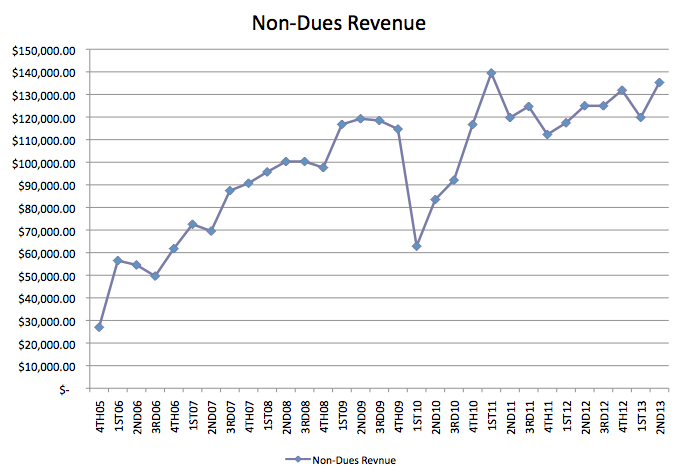
The impact of raising our per member revenue through more effective non-dues programs has been amazing.  The following graph illustrates our growth in annual non-dues revenue:


As you can see, our non-dues revenue has grown from less than $30,000 a year, to now almost $140,000.

One of the biggest drivers of that new non-dues revenue is online education and training.  Here's how online education fits the criteria for the perfect non-dues revenue program:

  • The association can do it more effectively than the members
  • It has high profit margins
  • It takes minimal staff effort with the right learning management system

As of this year, our association has an online learning academy that:

  • Generates almost $100,000 in annual revenue
  • Has over 350 course enrollments a month (over 32,000 in 7 years)
  • Has saved members over $2,000,000 in training costs over 7 years
  • Takes less than one man hour a week by staff to administer

Since its inception, our online academy has been able to deliver high quality content, in a user friendly environment, at a significant savings to our members, while driving extra revenue to the association annual budget.

I highly encourage all associations that do not have an online training strategy to seek one out.  If you have content in any format, or an industry professional you can partner with in a revenue sharing arrangement, you are sitting on the same opportunity to drive new revenue to  your association.

From my experience, the keys to a successful online learning strategy that engages your members in the program are as follows:

Need to Establish a Culture of Training Within Your Membership
It is proven by studies that companies that train their employees have higher morale, more confident employees, less error rates, higher gross profits, embrace change and accept technology easier.
Associations need to brand that thinking in order for members to take training serious.  They need to see the positive impact training will have on their career or business profits/productivity.

A User Friendly Learning Management System (LMS)
Whichever LMS you choose, you must have the following three items for you to maximize net revenue and minimize staff involvement:
  • Content creation, of courses, is point, click, upload environment
  • User friendly to the member in navigation
  • Cost structure to your association that allows your association to maximize your revenue
Content That is Relevant to Your Members Needs
Associations typically have content without even knowing it.  If you have written content, videos, power points, or past conference sessions, you have content to consider for your online learning center.  If you don't have that, you may have an industry professional, who for a 2-year revenue sharing opportunity, would create content for your association.  We gave an industry professional 20% of course revenues for two-years and he created 43-hours of videos, power points, and tests for us.  The point is, every association has content.  You just need to find it with yours, get it online, and sell it.

Certificate Specialist Program to Keep Members in the Program Long Term
We have found, employees love to accomplish training goals, and employers love to post those certificates of those who reach their goals.  It looks good to customers and motivates the other employees.  Certificate programs are easy to create.  You don't need to certify that someone is qualified at a certain level of performance...that comes with liability.  What you can easily create is a certificate program that certifies a person has taken at least so many hours of training and worked for at least a certain period of time in the industry.  The certificate demonstrates they have had some minimum level of knowledge based, and on-the job training.

Unlimited Subscription Model Availability
99% of our training engagement comes from members who purchase an annual subscription for unlimited use of our online learning academy.   With the financial cost structure we had with our LMS, it made it possible for us to take the video rental model of purchase courses one at a time for a certain price, or pay a higher price and get unlimited usage of our over 200 hours of training for your company.  Members jump all over the unlimited subscription model given it was highly competitive, provided them a group account to track all their employee's progress, and everything was tracked online, so it fixed their training budget each year.

In closing, I would encourage anyone reading this post to research and explore an online education strategy.

Wednesday, June 26, 2013

Tracking Your Membership Engagement... It's An EYE OPENER

An amazing thing happened this past month in the area of membership engagement.  Our Chief
Administration Officer, in charge of all our data, downloaded all our member activity to an excel spreadsheet and passed it onto me to review.  As I started looking over the data, it became apparent that we, for the first time, had the data right in front of us to truly measure our membership engagement in an easy and readable format.  We could sort and categorize members by:
  • Very engaged
  • Actively engaged
  • Somewhat engaged
  • Not engaged
This was incredible because now we can start targeting these members with different messages depending on their engagement.   The numbers showed we have 84% of our members engaged in one of more programs or services that are meaningful to their organization.  A more detailed view looked like this:

- 14% - Very Actively Engaged (6 - 11 programs)
- 26% - Actively Engaged (3 - 5 programs)
- 44% - Somewhat Engaged (1 - 2 programs)
- 16% - Not Engaged (0 programs)

Here is the key behind membership engagement:  Many look at engagement through the eyes of their meetings and volunteerism.  The philosophy being that if you don't come to meetings or volunteer, then you aren't engaged.  That couldn't be farther from the truth.

Many associations struggle because past coming to meetings and volunteering, their is no "actual" value.  It is "perceived" value.  The biggest mistake you can make as an association is to try and sell a "perceived" value to your members.

I was sitting in an association meeting I'm involved with recently where the staff liaison to the membership committee said that on their last conference call, everyone was stating, "If they don't come to our annual conference, we don't know what to tell them on why they should be a member."  That's a serious problem.

Keep in mind, according to the 2011 Marketing General Association Survey, only 22% of members on average attend their annual conference.  This leaves 78% unengaged with the association through their meetings.  Another figure to keep in mind is that the #2 reason members stated they dropped membership was a "lack of engagement" in the association.  Hense, if they don't come to meetings or aren't a volunteer, your value proposition is in serious jeopardy.

Knowing these two stats should send a RED FLAG up the fire pole that, as an association, you need to have some very specific programs or engagement for those non-attending members of your conference.

When analyzing this, there are three types of member segments that engage in your association;

1) Informational - They get data from you in one way or another
2) Transactional - They purchase something from you
3) Emotional - They volunteer or attend meetings for face to face networking

The easiest members to keep around are the emotional members because they have a connection to a
human being or the "cause" that keeps them in the association.  That is a minority in most memberships.  As the numbers showed above, the vast majority of members are those who are information or transactional.

When we looked down our list of benefits on the member engagement spreadsheet, we realized that we have 14-benefits that play a key role in any member's business.  Having members broken out by engagement segment will give us a marketing advantage because now we can thank and reward those who are really engaged and encourage those who are not.

The moral of the story is:
  • According to Marketing General's study, member engagement plays a huge role to non-attending members maintaining their membership.
  • Have you measured, in some fashion, your member engagement?
  • Have you separated your members into the 4-categories of engagement?
  • Do you have a communications plan to send different messages to each?
  • Do you know who your informational, transactional and emotional members are?
  • Is your association's value outside of meetings and volunteering "perceived" or "actual"?
When it comes to providing value, their are three types of benefits for your association to provide:
  • Those members get for free 
  • Those the association will do whether they are members or not
  • Those the association can do more effectively together than members can do themselves
I would encourage everyone reading this post to list every benefit a member can take advantage of and ask yourself two questions for each:
  1. Is this benefit a "perceived" value or "actual" value to the member?
  2. If it is "actual" value, state on paper the answer to, "How does the benefit have a lasting and measurable impact on a member?"
If you can answer "actual" to question one and have a good answer for question two, then keep the benefit. All others, toss because they have no real value to the member.

Get with your leadership in 2013 and build your membership engagement strategy.  Look at the different segments of engagement, send them more targeted messaging, design benefits that have actual value and are things you do better than your members can do themselves.

A highly engaged membership drives a higher level of retention.

Wednesday, June 5, 2013

The Perfect C.P.R. for Associations To Get Their SWAGGER Back!

Have you ever reached a point in your association where you feel like your organization is on the verge, or is currently drowning in the wrong strategic direction, marketing strategies, member apathy, tradition, or board politics?  Do you feel like you are SO under water that you will never see the light of day again?  Many associations I network with around the country are currently suffering from some, or all of the above mentioned issues.

Let's examine the numerous potential root causes that can lead associations to this point, including:


  • Poor board decisions
  • Being close minded to the change in demographics within the association
  • Not seeking to raise the value proposition to something meaningful
  • Continuing to do things they way they have always done them
  • Refusing to change with the market of associations
  • Ignoring technology advances
But take note...things are never as bad as they seem, and you can crawl, fight, and swim your way back to the surface.  All you need is effective CPR for your association!  In my experience, associations that are drowning in the above issues, really need to start some CPR to bring their association back to life.  CPR stands for:
  • Charisma
  • Passion
  • Relevance
Let's look at each:

CHARISMA
Members today don't just want programs...they want their membership to be a meaningful experience...a lifestyle where they see strength in numbers and feel a swagger by being a member of the association.  Think about it...have you ever walked down a convention hall at 10:30 pm when there are three or so conferences going on at the same time?  You always pass on the ones where there is nothing going on inside to speak of.  ...but the one where you hear amazing music, maybe some dancing, people engaging one another in discussion...then you stop and peek in because you want to know what's going on, and most likely would love to enter and find out what's so exciting with this group.  That group has CHARISMA!  They saw their final night dinner as much more than just a closing dinner...it was a chance to make memories, network with others, and emotionally connect with people.

I recall at our latest conference, being out with one of our biggest supporters.  He stood up at a dinner
of about 20 of us, and gave a toast.  With conviction, he said the tag line I say at the end of every MTI TV video:  "HERE'S TO NOT JUST BEING STRONG, BUT TO BEING MTI STRONG!"  I have to tell you, as the CEO of this group, my heart started racing, and I wanted to get emotional because I saw for a moment that we were tapping into our member's emotions.  It was awesome!

So my question to you is, does your association have CHARISMA?   Does your outreach to members draw emotion?  Do members feel a swagger about who they belong to, so as to say..."don't mess with our company, we belong to our association!"

If your association does not have CHARISMA and a swagger, I suggest you look to appoint someone to the position of "Charisma Energy Officer."  This person's purpose is to figure out how to utilize all available meeting, communication, and volunteer resources, to create the same CHARISMA you see in NASCAR and WWE Wrestling.  Those groups are the best at tapping into their fans passion and emotion...and it pays!

PASSION
PASSION is something that can be leveraged out of CHARISMA.  Many members will already have a passion for your association for the following three reasons:
  1. They want to be a part of something bigger than themselves
  2. They want to be a part of something that is exciting
  3. They want to be a part of an organization that will empower them to get involved
Members who don't have that natural passion can be won over in time.  As these members see the level of emotion growing in the association, they see great things taking place, they see transformation in the industry, and they connect the dots of that transformation to better performance within their company or profession.  They can develop a PASSION for your association.

To create passion, it is a MUST that you implement an active video strategy for your association.  Members can't get excited and develop passion for what they can't see or hear.   I hardly EVER see people getting emotional over something they are reading in a newspaper, but people watching talk shows or news stories get excited, irate, angry, happy, and down right emotional.  It's because video brings people into the experience.  

Remember, an association without video, is like a good steak with no taste.  Do what it takes to create passion in your association.  Your members who don't attend your meetings need to have the same emotional connection to your association, as the members who attend meetings.  

RELEVANCE
RELEVANCE gets back to one phrase I have stood on as the key to membership recruitment, engagement, and loyalty:  

"Doing things for your members they can't do themselves effectively"

If you put all of your focus on this one area, you will maximize your value proposition and member engagement.  Too many associations are still hanging onto benefits and programs that fall into two categories:
  1. Those members can get for free
  2. "You are going to do that whether I'm a member or not"
Doing things for your members they can't do on their own is the "golden handcuffs" to keeping members forever.  When a member considers non-renewing, the thought that needs to come to mind is, "We HAVE to renew or we are going to lose _________(list of key association benefits)."

My question is, does your association have that set of benefits that give you a lock on members, and
that members need, to gain a competitive advantage in their company or profession?  If not, you need to get working on them now.  Members are spending big dollars outside of associations on consultants to help them change their business models and become more efficient.  That money should be going to the association, because the association is able to leverage those dollars more effectively as a group.

Quit thinking small, and begin thinking large!  Don't be afraid to think BIG!  Ask yourself, "if we could do two things that would TRANSFORM our member companies, what would they be?"  Then go DO IT!  Five years from now, you will be looking back saying, "I never thought we would be able to do that...it was once just a dream, but now it's a reality, and our members love us for it."

Don't drown in the water of bad strategic planning, apathetic members, and bad programs.  Give your association the CPR it needs TODAY!  Hit them with some CHARISMA, PASSION and RELEVANCE!  It will change their life!

Monday, April 29, 2013

Creating a Conference That Rocks Your Members and Makes Them Fans

I have recently returned from the Annual Spring Meeting of the association I run and have been asking myself the following question:

What separates our meetings from many other association meetings who are struggling to get members to attend with a level of excitement that engages attendee's emotions?

I began to ask that question throughout the meeting because half our speakers commented from the stage to or members... "they have been around very few association meetings where the bonds were so tight, the atmosphere was so welcoming and level of excitement was so high."  I also had numerous members, presidents of companies, come up to me and say, "Tom, MTI is without a doubt the most exciting organization we belong to."  

That speaks right to a CEO's heart.  It's what we strive for.  

As I've given a lot of thought about our meetings compared to what I hear from many others, I believe the following 5-elements of our meeting drive the bonds, emotions and excitement our members experience that create their desire to want to return.  These are things you may want to think about in your meetings:

LOCATION, LOCATION, LOCATION
As with retail, location makes a huge difference in the attitude of an attendee.  The question here is, do your members see your location as just meeting, or an opportunity to experience a city and resort they might not be able to afford individually.  Having the right "value" at great locations can greatly increase your attendance due to many attendees bringing their spouses.  When the spouses in an association begin to build relationships, they never want to miss a meeting.  Especially when the locations are amazing.  This is an incredible benefit of being a member of an association in that the association can negotiate amazing concessions and room rates at 5-star resorts for members to enjoy a few days away from the office and network in an exciting location.   When you have the right locations, attendees begin to see the meeting as a mini-vacation.  You know you have them hooked when they build their annual calendars around your meetings.  Once you have them hooked, its important you have your meetings booked well in advance so they can get them on their calendar.

ONLY MEET UNTIL NOON, 12:30 AT THE LATEST
Our members have a friendly bond like I've never seen in any other association.  Even our most fiercest competitors hang out together.  I feel the reason is we provide them as much time during the day to hang out and really get to know each other as we do learning in the classroom.  Giving everyone the afternoon off provides a couple of key features:
  1. The brain can only absorb so much.  A full day of learning in my opinion is too much.
  2. It allows attendees to get to know each other on a more human and emotional scale and build bonds.
  3. It gives attendees the time they need to brainstorm the application of the ideas they learned in the classroom.
  4. It provides an opportunity for your attendee to really soak in the great location you have chosen, which gives them a new perspective on their industry and refreshes their personal spirit and passion.
GIVE THEM A MIDDLE NIGHT OPEN TO ENJOY THE NIGHT LIFE
So many cities have an amazing night life with food, music and attractions.  It is imperative that you give them a night to experience it.  If you have chosen a great location and provided them the afternoon to recharge and refresh, they are in the mood to go experience the fun your chosen city has in store for them.  If you have kept them in the classroom until 5 pm, then reception and dinner, most are too worn out to attempt to go see the town.  We started giving members the middle night free a number of years ago and they have loved it.  It allows suppliers to take customers out to dinner and friends in the industry to connect as small groups.  The key is a 1-hour meet-up reception from 5:30 to 6:30 that brings those together with no plans, to connect and make plans with others for the evening.

A VIBRANT NIGHTLY HOSPITALITY SUITE FOR THE BOARD TO HOST
Every association's board needs to be connected to the membership.  More members than you know have a desire to stay up networking past the end of your nightly functions.  Hosting one common place where they can all hang out together creates an extra bond you can't put a price tag on.  If everyone ends up in small groups all over the place, things are fragmented.  But when they all show up to a common room and can network, laugh and enjoy the night together, the strength you want to see build among members begins to take shape.

EXCITING ENTERTAINMENT ON THE LAST NIGHT
Your closing dinner is the last opportunity to showcase why your association is an awesome and exciting place to be.  This is a night to, one last time, engage the attendees' emotions moving towards your next meeting.  You need to figure our what that last exciting moment needs to be at your final dinner to have the thought in your attendee's mind be:  "I can't wait until the next conference!"   For us, we always have a local band who plays great dance music to entertain the last 2-hours of the night.  We balance the room out where people who want to dance can dance and those who want to just keep networking can enjoy that as well.  At the end of the night, everyone feels a "good" drain on their energy because they have expended it in a way they love.

I would encourage you and your meeting team to give some thought to these ideas.  With the new generation being very experiential, it will be imperative you do more than just deliver content.  You need to deliver emotion, memories and an opportunity to bond more closely with the other attendees for network expansion.

Wednesday, April 10, 2013

Great Leadership is Knowing When to Lead Members vs When to Facilitate Process

In my years of experience, one of the biggest frustrations with executive staff of any association, is knowing when to "lead volunteers" and when to "facilitate the process."  Working within the daily grind of all the association programs, causes an association executive to really develop a sense of, "this is mine" attitude.  You feel like you have been there from the beginning, you were the driving force behind the ideas, or you put forth unbelievable effort into launching and engaging a successful program.  Over time, you begin to feel like the association is, "your business", and you begin to LEAD it as such.  You feel that way because your hands are in it everyday, as opposed to your member, who has their hands in it periodically.  Here is the good news...your board members/leaders, feel the same way about their outside company advisors, bankers, or a board if they have one.

It's not a bad thing to feel.  It's an emotion you simply need to understand, control, and have the right attitude about.  I always say, "You need to run the association as if it were YOUR business, knowing that it is NOT."  This is easier said than done for many.

If you want to sleep easier at night, have less stress in your daily work, and want to leverage the efforts of many to increase your quality of life, you need to realize, "it isn't your association and never will be."

Knowing when to FACILITATE the process to empower your members to do the work of the association, is key to leveraging your leaders in doing the work of the association.


Granted, every association has its own persona regarding this balance of LEAD or FACILITATE.  Most associations break down into one of the following categories:

  • The association is hurting, and your board/leaders give you the keys and say, "FIX IT."
  • The association is hurting, and your board/leaders, along with you, "WORK TOGETHER" to pull it out of the valley.
  • The association is doing well, and you are doing the work that your board/leaders are charged to do, but never seem to get around to it, leaving you to, "SAVE THE DAY."
  • The association is doing well, and your team has a great blend of staff and volunteer engagement to "GET THINGS DONE."

I ask the question of these, when do you "lead the volunteers" and when to you "facilitate the process?"

Remember, it's their association, they have the last say in priorities.  An association executives job is not to determine the priorities or make the final decision, unless requested by your leadership.  It's your job to present all the relevant facts, potential outcomes and consequences of each, and then let your leadership set the priorities and direction for the association and its initiatives.

I believe that knowing when to lead and when to facilitate is a moving target.  Each one of those scenarios above calls for both staff and volunteer engagement in the process.  I find too often, many association staff just accept that, "every action that comes from a board or committee meeting, is staff's responsibility to 'make happen'."  This is not true.

It is critical the association staff understand when the workload is full, so they are able to ask their leaders/volunteers for help in the process.  If there is no help in the process, then the staff needs to ask the board or committee, "what do you want to put to the side, or eliminate, to take on this new project?"  ...Or,"are we prepared to add money to the staff budget to take on more staff to handle the new initiatives?"

When the workload gets larger from board or committee initiatives, there are only a couple of choices:

  1. Current staff just assumes the responsibility
  2. Hire more staff to take on new workload
  3. Volunteers step in to help with the process
  4. Eliminate projects to make room for new ones
Most tend to immediately pick #1.  I believe it should be #3 first...then #2...then #4.   It should never be #1.  An executive should never allow the workload to get so overwhelming for their staff, that they become inefficient, burned out, and ineffective for the members...but it happens everyday. 

Associations should never be staff or volunteer driven.  They must be a perfect blend of human
resources and talent each bring to the table.  Great leaders are able to access the talent they have within their grasp in both staff and volunteers, and orchestrate them in a process with the priorities of the board to maximize their effectiveness for the association.

My encouragement for you today is to take a moment to step back, look at every project your association is working on, and analyze if you are leveraging the right balance of staff and volunteers in the process.  I'm of the belief that having more volunteers involved in the process leads to a more vibrant and engaged association.

...but that would cause you to give up control...try it sometime! 


Monday, March 11, 2013

Member Engagement: It's NOW or NEVER

I've been sitting in sessions at the ASAE Great Ideas Conference, and I'm amazed at some of the things I've witnessed that display how some associations are disconnected in key ways to growing their association.  Here are two examples:

In one session, association executives wanted to talk about how to get their members to see their "perceived value", yet when asked if they wanted to expand and talk about non-dues revenue generation, only 4 hands went up in a room of 80+ people.  That was a missed opportunity.

Then the comment was made early in a session that the new, younger generation is not a set of "joiners", yet later in the session, it was noted by someone that the coming generation is one of the most passionate and cause related generations in history.   This could be a missed opportunity.

Hear this next comment:   In order to maximize member engagement and association loyalty, you MUST get past perceived value and begin generating "ACTUAL VALUE."  Actual value comes from benefits that go PAST your membership dues; this means in large part, creating non-dues revenue programs. 

When looking at member engagement, it is critical you understand which one of these three categories your members fall in to:

Informational
These are members who tap into your association for your newsletter, magazine, journals, online resources, etc.  They aren't active or buying anything.  They just value your information.  The danger of this group is that most information is now available for free through the internet, therefore, there is no real dependance on your association.

Transactional
This group are members who spend money to purchase some type of resource from your association.  This could be classes, projects, technical data, etc.  This is a great level of engagement.  However, the downside of this group is, many items and services that associations provide can now be purchased or found outside the association.

Emotional
This group is the most committed because they have taken an emotional step through attending meetings or volunteering within the association.  Through this emotional step, they create bonds with other members that take their engagement to a personal level, which ties them closely to the mission of the association.  This is the strongest engagement you can have in an association.  The emotional member wants to be a part of something bigger than themselves, they want it to be exciting, and they want to be a part of an organization that will empower them to do so.

It is also vital in your engagement strategy that you:

  • Understand which members are in each of these three categories
  • You ensure that you have great value in each to attract members
  • Your systems and marketing make it member friendly to move from informational to transactional, and from transactional to emotional
Engagement means members reach out to the association in some fashion to connect with it for some benefit.  When looking at benefits, there are 3-types that associations can have:
  1. Ones that members can access for free outside the association,
  2. Ones the association is going to do if they are a member or not (government relations is an example),
  3. Ones that the association can do together more effectively than members can do themselves.
If you want to maximize your member engagement, it is vital that you focus on option 3.  These benefits are the "golden handcuffs" that engage members and increase loyalty, because they can't get these anywhere else as effectively as the association is providing it to them.  Some of these you charge for, some you don't.  To discover these, you must have a good grasp of:
  1. Your member's daily problems
  2. The threats to your industry and members
  3. How your member's business and/or daily functions operate, better than they do
For those of you looking for a measuring stick of how successful using the above strategies for developing your engagement strategy can be, it has lead to a 28% increase in our per member revenue and an 865% growth in our association's net worth over the last 7 years.

Knowing what category you member's level of engagement is, and putting focus on things you can do more effectively, that your members can do individually, will have an immediate impact on maximizing your value proposition to your members, and turn you from marketing "perceived value" to providing "actual value."

Monday, February 18, 2013

Finding Clear Skies in the Fog of the Future

You know, it's a funny thing about associations...I often wonder how association executives can tell the story of their association with "passion" when they don't even participate as an association executive in ASAE or state SAE.   Yet they wonder why people in the association they lead aren't members.  Execs don't attend an annual conference, yet wonder why their members don't attend theirs, and most of all, association executives don't participate in industry-wide benchmarking studies, and wonder why they struggle to get participation in their own.

I believe participation as association executives in things like membership, meetings and benchmarking, in the world of associations, is sort of like "paying it forward."  It's walking the walk, meaning what you say, and "believing" what you say about the power of associations.

With that said, I want to put focus on an area that I feel associations are losing out on.  It's a benefit that associations of the future should put a lot of time and effort in developing.  Associations that succeed in the future will be associations that "do things for their members that members cannot do themselves effectively."

One of the most powerful benefits that no member can do themselves effectively is industry wide benchmarking.  It is costly for any one company in both time and money to organize, coordinate and fund the benchmarking effort.  Hence, it is the perfect set of golden handcuffs for an association to wrap around their members.

No matter what industry, benchmarking provides unbelievable inside intel about what is going on within any set of member companies and the industry.  With the economy and business climate being in such a fog, no one feels great about hiring new people, making capital investments or just feeling good about the daily direction of where you are headed.

It is a powerful source when you can open up a set of industry data to see where trends have been and where they are headed.  Especially given that trends have been developed from "actual data."   Our association does monthly sales trends, as well as, quarterly operational cost studies.  It's all online, secure, confidential and easy for members to input data and download real time reports.


We believe benchmarking clears the fog of the future that provides clarity of where the industry is headed, where areas of growth are, and what areas of your business need improving.  You can't know that just looking within your own company.

Every business has 5 to 10 major numbers that can tell you how that business is doing.  I want to challenge association executives reading this to do two things:
  1. Set up a benchmarking task force in your association, and have them try and nail down the 5 to 10 meaningful numbers that could tell you everything about the direction of the business in your industry.  These can be related to sales figures, sales calls, or any operational cost items.  Then survey your members to see how many would participate if they could receive a quarterly report of their figures compared to the industry and local region.
  2. TAKE TIME to participate in one of the most powerful association benchmarking studies in the U.S.  This study is put out by Marketing General with incredible data to provide to your staff, association leadership, as well as, any membership committee.  It shares intel on membership recruitment, communication strategies, and non-dues revenue structure.  Marketing General brings to associations nearly 35 years of testing, market research and data analysis of member behavior and membership marketing.  Simply put... they deliver the intel you need to know to grow your association.
I performed the survey for our association and it only took 15 minutes.   Our association will reap huge returns from the data I will get back from this comparative report... you can to if you invest the 15 minutes.

CLICK HERE to participate in their study.  DEADLINE IS:  Tuesday, Feb. 19.  Don't Delay!

If you are serious about growing your association, you need to look into benchmarking for your association members and take the Marketing General Survey.  Your members and board leadership will thank you.

If you have any questions on benchmarking, feel free to contact me at tom@tommorrison.biz.


Monday, February 4, 2013

How to Have the Golden Hand Cuffs on Association Members

For years, back in the 50's through the 90's, individuals and organizations were members of associations to "just belong."  It was a must.  Nowhere else could you access new products, information, key industry data and a vast network of people to help you succeed in your industry.

Associations had a built-in set of "golden handcuffs" for value because the internet did not exist as it does today.   They were the only real place to access new product launches, information and networks of people.

Then a life changing event happened for associations, in the 1990's, AOL and Google became the information highway for everyone.  Now everything was different...information was at the fingertips of anyone who had a computer.   Over the last 20+ years, the internet has taken over an area that was once so vital to associations..."Information and Data".

The 800 hot-line to the association offices is no longer needed to get critical updates on legislation and industry news.  With a couple of key strokes and Google, you can have over a billion pages at your fingertips to filter through.

Hold on!  Did I just say a BILLION?  Yes, and sometimes more...  Now why would someone possibly waste half a day, if not possibly an entire day, sorting through what is right, wrong or even legitimate? BECAUSE IT'S FREE!  That is a major problem for associations.  Information is now free and at everyone's finger tips.  The question now arises as to, "If information is so available and free, then why are associations concentrating on that for member value?"

In order to understand the answer to this question, you need to understand the types of benefits and their relationship to member value.  Here are the three types of benefits any association can offer:
  1. Those things your members can get for free without you (adds zero value to the association)
  2. Those things you are going to do whether I'm a member or not (adds some value to the association)
  3. Those things you do for your members they can't do themselves effectively (maximizes association value)
You see, any association that has most of its efforts going into #1 & #2 are typically struggling to find a connection with their members...especially the younger generation.  Things like an informative newsletter, government relations, insurance programs, etc. aren't adding any value because these are areas that were once a "lock" for associations, but are no longer.

However, associations that put 100% of their focus on identifying #3, DOING THINGS FOR YOUR MEMBERS THAT THEY CAN'T DO THEMSELVES EFFECTIVELY, will rule the day in the future!  This takes a little effort to understand your members' businesses better than they do...it calls for surveying your members to understand what they feel their biggest problems and challenges are...it requires you to LISTEN to them, and then ACT on what they say.

Remember, in the world of associations, innovation isn't developing the next big mobile app or device.  It's simply creating solutions that solve your member's problems and challenges.  If you do that, they will trust you, know that you care for them, and you will have great relevance in the life of their business.

I take my own association for example:  Seven years ago we chose to put all of our focus on #3 above, and we began listening to our members with the intent of restructuring our strategic plan to reflect what they said were their areas of challenge.  We came away with the following areas of focus:

  1. 24/7 Online Training
  2. Effective Face to Face Networking Conferences
  3. High Energy Leadership Training Relevant to the Younger Generation
  4. Financial Benchmarking and Forecasting
  5. Online Member Matching for Networking
  6. Tools to Help Members Reduce Findings in Their Accreditation Audits

You see, our members could decide to do any one of these for themselves, but it would cost them tens of thousands of dollars to do it, and it would take them away from running their business everyday.  These 7-things aren't just a Google search and look-up...it goes way beyond that!

Since our Association put its focus on these 6 areas in 2006, the Association has grown over 18% in annual dues revenue, 28% in per member revenue, and 840% in net worth...with the largest economic downturn in our history.

Do we have a set of "golden handcuffs"?  YES, because the 6 areas noted above are crucial to the success of any company within our industry, and they can't get it anywhere else, nor can they do it themselves effectively.

When an association gets back to the basics of why they exist:

1) Organize themselves
2) Coordinate their efforts
3) Leverage the costs over many
4) Build trust as a group
5) Do things together they can't do themselves effectively

...they will begin to see member value, engagement, and loyalty start to grow to levels they never thought possible.

No matter what the size of your your association, if you want to maximize member value, engagement and loyalty, check out my half-day Association Innovation Think Tank by CLICKING HERE.

It is helping association boards/staff find their way to higher levels of excellence for their members and industry.


Wednesday, January 9, 2013

DOTS....Will You Be Collecting or Connecting

As I write this blog, our Association is ending another record year in revenue and net assets for 2012, further strengthening us to do some dynamic things for our members without charging extra dues.  Our incredible run over the last 7 years has not been by luck, but by a systematic and strategic set of innovative measures to maximize membership value.

Whether it's your association staff, volunteers, leaders, or just your members, we push a massive amount of content and information through all those channels.  The options available to us are unlimited in pushing out content including:  social media, conferences, print newsletters, e-news, videos, and blogs...you name it, it's out there.

This year the big question you need to answer is:  Are we allowing people to just "collect the dots" or are we helping them "CONNECT the dots" in our association?

You see, there is a difference.  If you are simply pushing out information, creating benefit programs, or writing down everything the speaker says at a conference and not connecting that information,  program, or idea to an action step to improve your members, career, or business, you are simply "collecting dots".  When you only "collect dots", you only have dues paying members and higher cancellation rates.

However, when you "CONNECT the dots" of information, programs, and ideas to specific struggles your members have everyday, you then CONNECT them to your association in an emotional way that leads them to be not just dues paying members, but BELIEVERS.

I'll give you a quick example.  I sit in conferences and watch people write down everything a speaker says without any regard as to what they are saying, and what it means to their association.  They are simply "collecting the dots" that will never move into action.  But then there are the people like us, who don't write anything down the speaker says until they say something that is an idea that can transform how we do something in our association...that is what we write down...and that is what we come back and execute.

You see, if you had the choice of your staff sitting in a classroom and writing 8-pages of legal pad notes of information, or having them skip the afternoon sessions and hang at the pool with 3 top association executives, where they learned 2 incredible ideas for your association, which would you prefer?

Most of you reading this would struggle with that because you say you don't pay your people to go to the pool at a conference.  You pay them to go to class, yet you passed on the "CONNECTION of dots" at the pool and went for simply "collecting dots" in a classroom.

Now don't get me wrong, I believe there is good work done in the classroom.  My point is, we have to think differently about our actions and truly ask ourselves as we make decisions on programs, communications, etc., is this going to "collect the dots" or "connect the dots" with our leaders, members, and staff?

Another example is when I was having dinner with a member and two of his key managers.  As we talked about the standards and audits that they have to live by, it became very apparent there was a service that our association could provide, that would be life changing for their business, and could help them to improve their process and save thousands of dollars in future audits.  That is a dot that CONNECTS them emotionally to our association and will bring us new members as well.  

Remember, you are better off having just 4 programs that "CONNECT the dots" for your members, than 35 programs that fill up a benefit page and just "collect the dots".

MEMBER VALUE is driven by the quality of impact of programs, not by the number of them.

I wrote a series of blogs in 2012 that can be of great help to you in working through this.  I would encourage you to forward all 8 of these to all of your staff and make them mandatory reading:
  1. How To Be a Real Change Agent in Your Association 
  2. Go BIG, Go BOLD, Go NOW
  3. Why the Traditional Association Model is Stronger Than Ever
  4. WOW... This Membership Thing Really Works
  5. Connecting the Next Generation to Your Association... Its Not As Hard As You Think
  6. Why Are You Here and Do You Know Your Vital Signs
  7. Why Boards Need to Innovate
  8. 5-Stages of Building Believers in Your Association
If your association is struggling to get your board or your staff to make the changes you need to make  to "CONNECT the dots", maximize member engagement, see new non-dues revenue for your organization, and build member loyalty, consider my half-day Association Innovation Think Tank.  It will put your association on the right track to "connecting the dots".

Those who are battling the strong winds, the ones who are most successful, are the ones who simply adjust their sail and change direction.